Enterprise AI
Designing an AI tool that employees would trust required solving a problem the product brief did not mention.
Global life sciences company (confidential)
2025-2026
Lead Product Designer
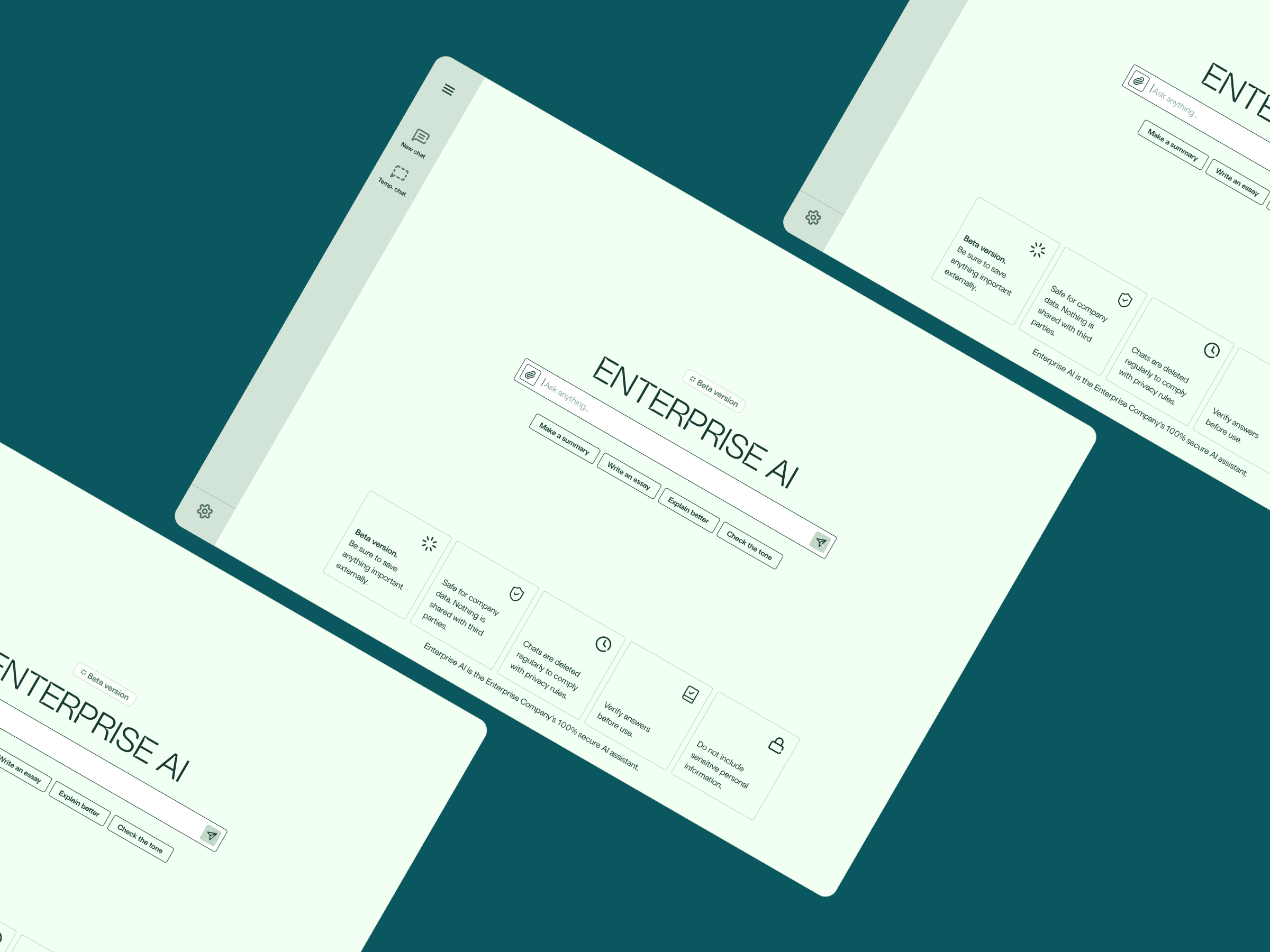
The problem worth solving
The brief was clear on outcomes: responsible governance, alignment with the corporate design system, and a product that would work for scientists in regulated environments and marketing teams alike. The problem worth solving was less obvious.
Employees confronted with a new AI tool carry legitimate questions: is this safe, what are my limits, what am I accountable for. The obvious design answer was a disclaimer. I chose a different framing: governance as a feature of the first experience, not as legal cover appended to it.
I identified two approaches. The first was a guided onboarding for first-time access, walking users through the interface and the governance rules before they started. This was the most complete solution to the problem. It required content that had not been closed before Beta, so I chose to document it and defer it to V1 rather than launch an incomplete flow.
The second was a layered system on the discovery page: persistent compliance cards giving users an immediate scannable summary, with an expandable drawer providing full policy detail on demand. The decision was to simplify this to static cards with a single sentence each and no link to further detail. With several governance rules requiring visibility, this produced five cards on screen. Without a controlled space to expand into, the information had nowhere to go. On mobile, the result was a viewport dominated by compliance content before the user had typed a single prompt. I implemented the decision, diagnosed that failure, and after Beta proposed reinstating the drawer. I chose to document that recommendation explicitly rather than present the shipped version as resolved. That documentation went to the business as part of the weekly status reports I sent throughout the project.
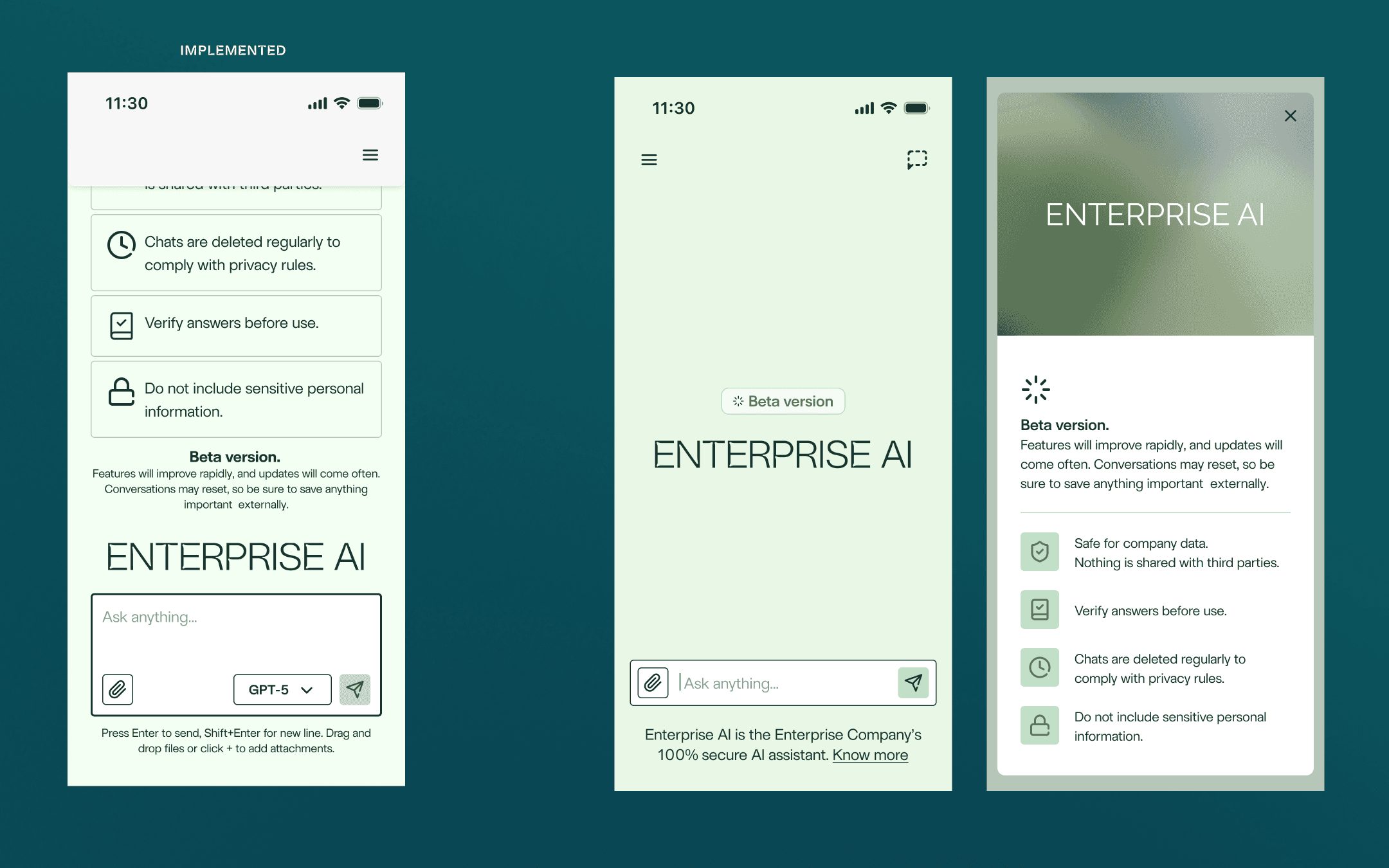
5 compliance cards stacked. Clear on desktop. Problematic on mobile.
The work we shipped
The corporate design system had no prompt input, no token counter, no inline governance alerts. Before Beta, I built a local component library as the foundation for experience consistency and compliance control. I chose to design each component to answer two questions simultaneously: what does it do functionally, and what does it communicate about accountability. The token counter is not a usage meter; it is a transparency mechanism. The inline alerts distinguish between guidance before action and information after it. These decisions were made before a single user interaction, and they were validated by how the platform behaved once people started using it.
After Beta, the process changed. Formal Scrum ceremonies ended and developers moved to Vibe Coding. Rather than resist that shift, I adapted my point of intervention: from specifying components in advance to reviewing solutions with developers as they were built. The design system became the shared language for those reviews, a reference both sides could reason from. Moving evaluation into the process, rather than before it, kept design relevant in a timeline that had already moved on.
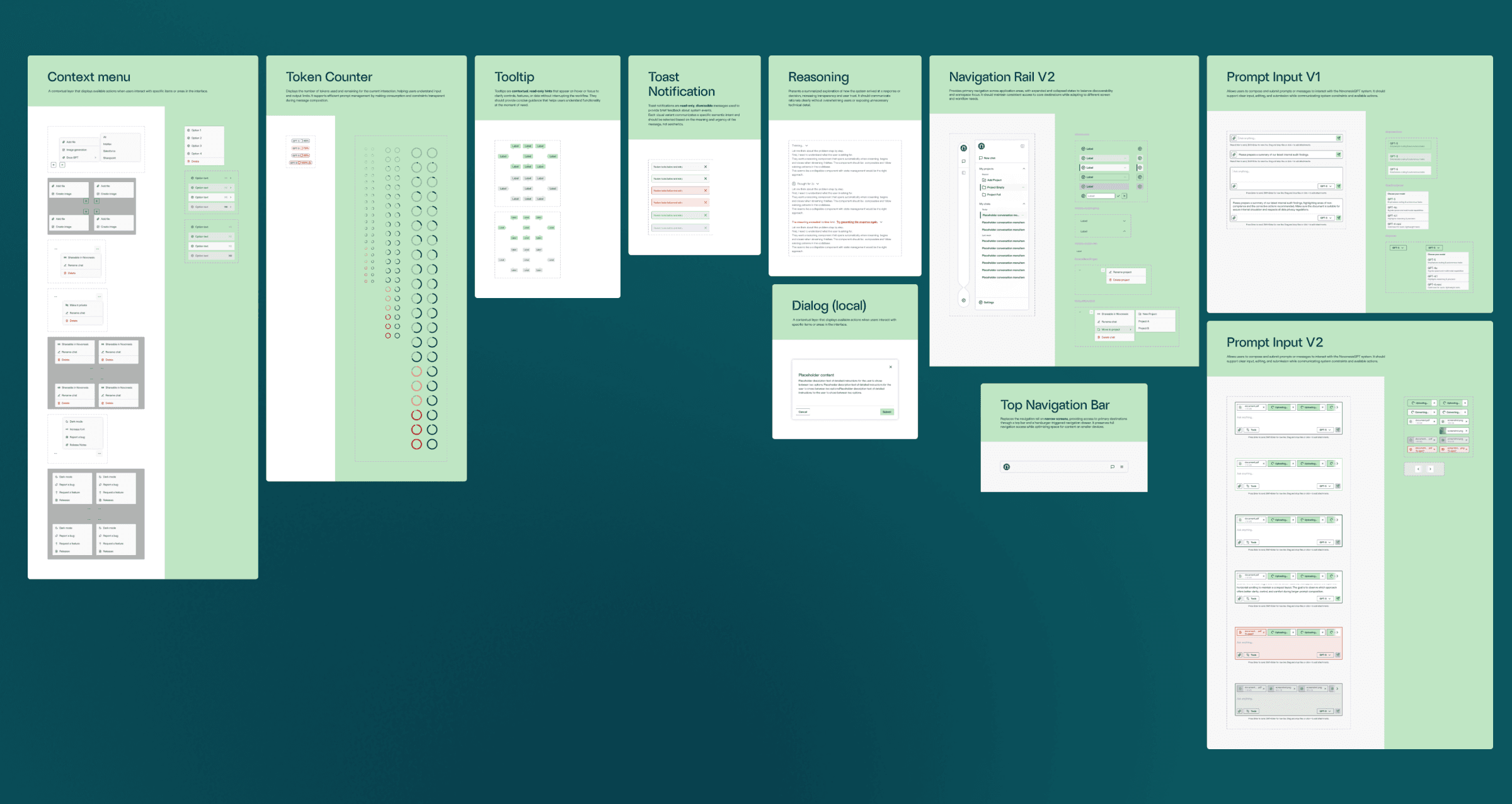
Local component library built for the product
The last deliverable
Two pieces of work did not ship. A tone of voice adaptation tool, identified in discovery as a high-value differentiator for commercial users, was deferred because the product architecture was not stable enough to implement it without creating debt that would need to be undone in V1. The drawer pattern for compliance disclosure remained an open recommendation after Beta. Neither exists in the current roadmap. Both were delivered as design documentation with rationale and conditions for revisiting.
In the 53 days following Beta, the platform grew from 929 to 2,540 registered users and from 2,132 to 14,000 conversations. The error rate fell from 0.2% to 0.002%. These numbers do not measure design directly. But they describe something design made possible: an environment trustworthy enough for people to return to, and stable enough for natural curiosity to take over. Employees found their own reasons to use the tool. Design's role was to make sure the experience did not get in the way of that.
Confidentiality notice
Work carried out at a global life sciences company. Proprietary data and visual identity omitted. Adoption data shared internally by the development team.