Cadi
Carlsberg
2022-2023
Sole dedicated Product Designer
The product I inherited
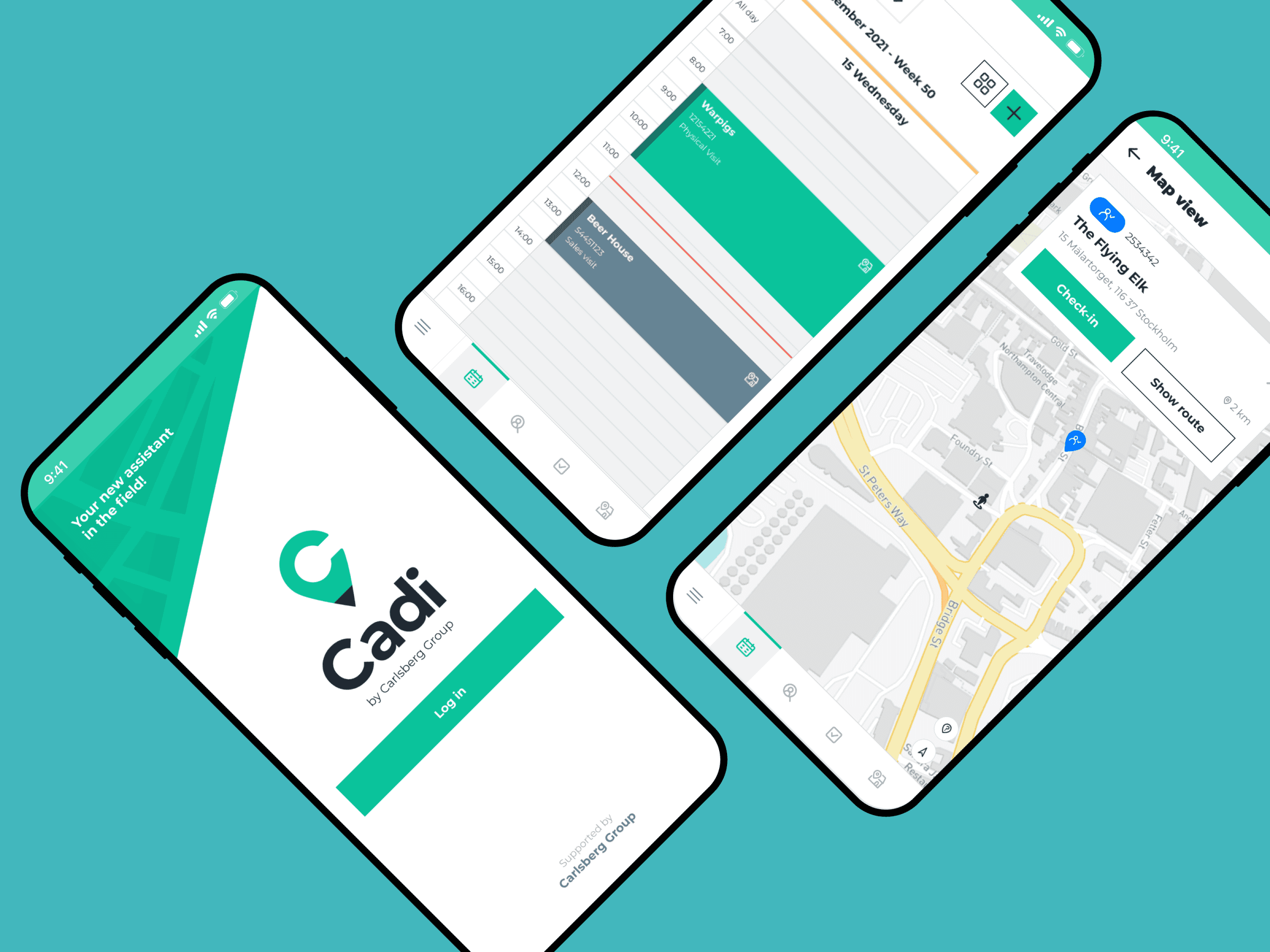
CADI is Carlsberg Group's Sales Force Automation tool, a web application used by sales representatives across 7 markets to manage customer visits, submit orders, run surveys, and coordinate with support teams. When I joined, it was post-MVP and in production, with a growing user base and no dedicated design presence.
I identified two parallel needs from the start: the product required systematic design revision, and the team needed a workflow to sustain it. Neither could wait for the other. I established a dual-track agile framework (an ideation track ahead of development, and a delivery track managing active sprint specifications), built the Figma workspace from scratch, and documented ways of working so the team had a shared understanding of what design meant in this context. By the time I left, CADI had become one of the most productive teams in the Digital Studio.
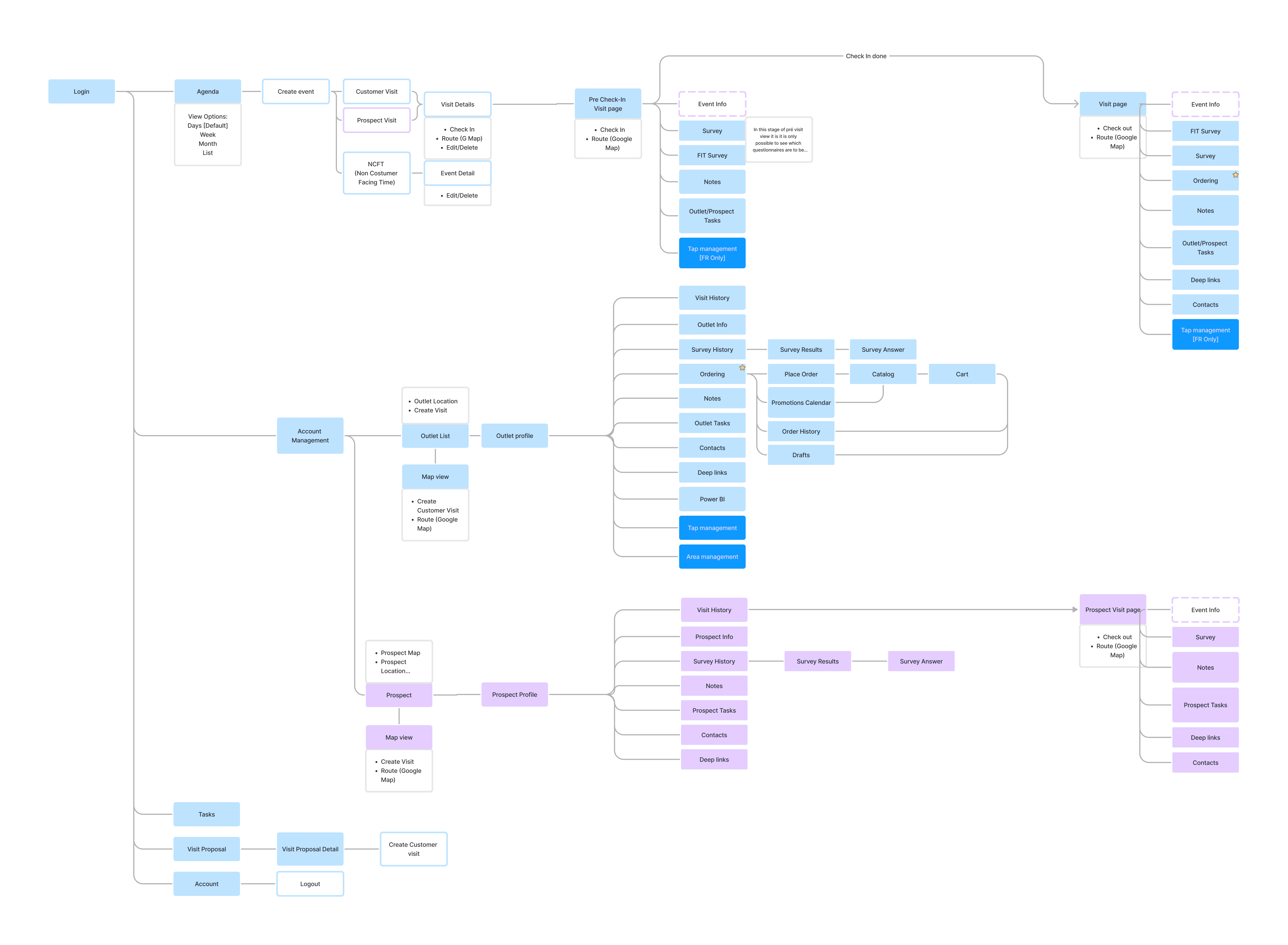
CADI app sitemap. Shows full product architecture and scale.
The system underneath the product
A year in, Carlsberg Digital launched Malty, a global design system for all digital products. Before adopting it, I made an assessment: Malty was being optimised for consumer-facing contexts, and CADI had fundamentally different requirements, dense information, frequent desktop use, and a field operations workflow. Adopting Malty directly would have introduced inconsistencies in both products.
I chose a different path. I created a CADI Local Library, a child design system built on Malty's foundations, with product-specific components documented as extensions, not exceptions. Alongside it, I developed a four-stage Malty Component Integration Plan to systematically replace custom solutions as Malty matured: inventory, integration analysis, custom solution assessment, and mapping.
The trade-off was explicit: maintaining two parallel systems (Malty and CADI Local Library) created design operations overhead managed by one person. I chose it because the alternative, premature adoption, would have compromised the integrity of both systems. Documenting that reasoning was as important as making the decision.
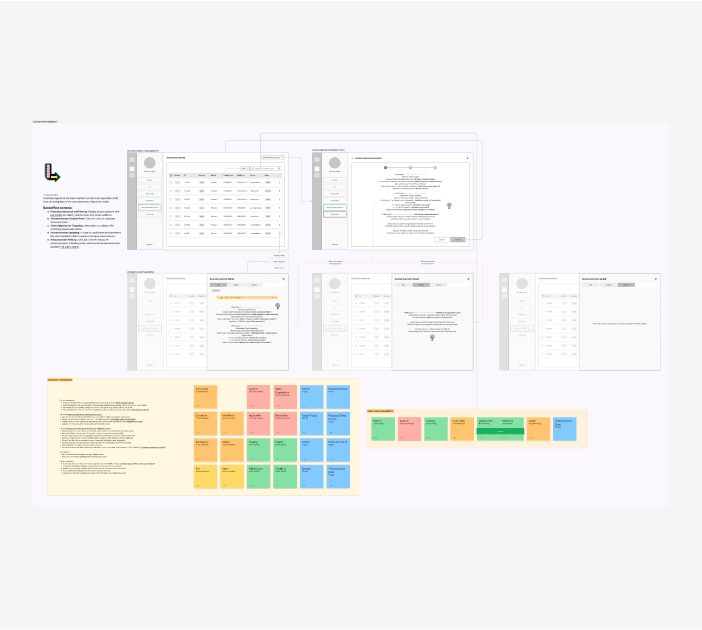
4 stages of the Malty Component Integration Plan
When research changed the question
BBefore touching a single screen in the ordering module, I asked a different question: what is the actual role of the sales rep in the ordering process, and what does that mean for what CADI needs to do?
In early 2023, I conducted a Phase 1 research study: 12 interviews with Sales Managers across 6 markets and a survey with 327 Sales Reps, triangulated with Google Analytics usage data.
The findings reframed the problem. In Italy (On Trade), 97% of order volume moved through the sales rep via SFA. In Finland (Off Trade), that figure was 3.5%. The rep used CADI almost exclusively during promotions. Denmark's Off Trade reps spent most of their ordering time editing EDI orders placed automatically by large chains, correcting stock discrepancies in-store. Sweden had largely moved reps away from ordering altogether years earlier.
These weren't variations on the same problem. They were structurally different jobs happening on the same platform.
The output wasn't a new UI. It was the Ordering Digitalisation Impact, a framework mapping all 11 market variations on a spectrum from low to high digital maturity, identifying which ordering capabilities were relevant at each point. That framework was shared with market stakeholders and used as a foundation for roadmap prioritisation discussions with the PO and PM. I also scoped and documented a Phase 2 plan, selecting Finland and Lithuania as target markets for field research, to ensure the findings could be built on regardless of timeline.
Sales Volume by Channel chart and Ordering Digitalisation Impact diagram.
The work we shipped
Three features were implemented during this period, each originating from user feedback surfaced through market manager calls and support channels.
Campaign Improvements. Feedback pointed to a mental model mismatch: the existing design assumed the rep already knew a campaign was active before they could act on it. I redesigned the campaign surface to be visible within the ordering flow itself, surfacing active promotions and dates in the product catalogue rather than requiring navigation to a separate module.
FIT Refactor. Expanding the FIT test from binary (yes/no) to multiple choice, open fields, and variable formats created two separate design problems: the rep's dynamic form in the field, and the manager's configuration interface in the back-office. I treated them as distinct products, because the users' needs were genuinely conflicting. The rep needed simplicity under time pressure; the manager needed granular control.
Prospect 2.0. When a third-party dataset was integrated into CADI's prospect database, the data models didn't map cleanly. Rather than expose that complexity to the sales rep, I absorbed it at the information architecture level, translating the corporate prospect classification framework into a status model showing the rep the evolution from initial contact to active customer. The feature was delivered in two iterations (2.1 and 2.2) to manage delivery risk, accepting a period of temporary inconsistency between front-end and back-office that was documented and closed in the second release.
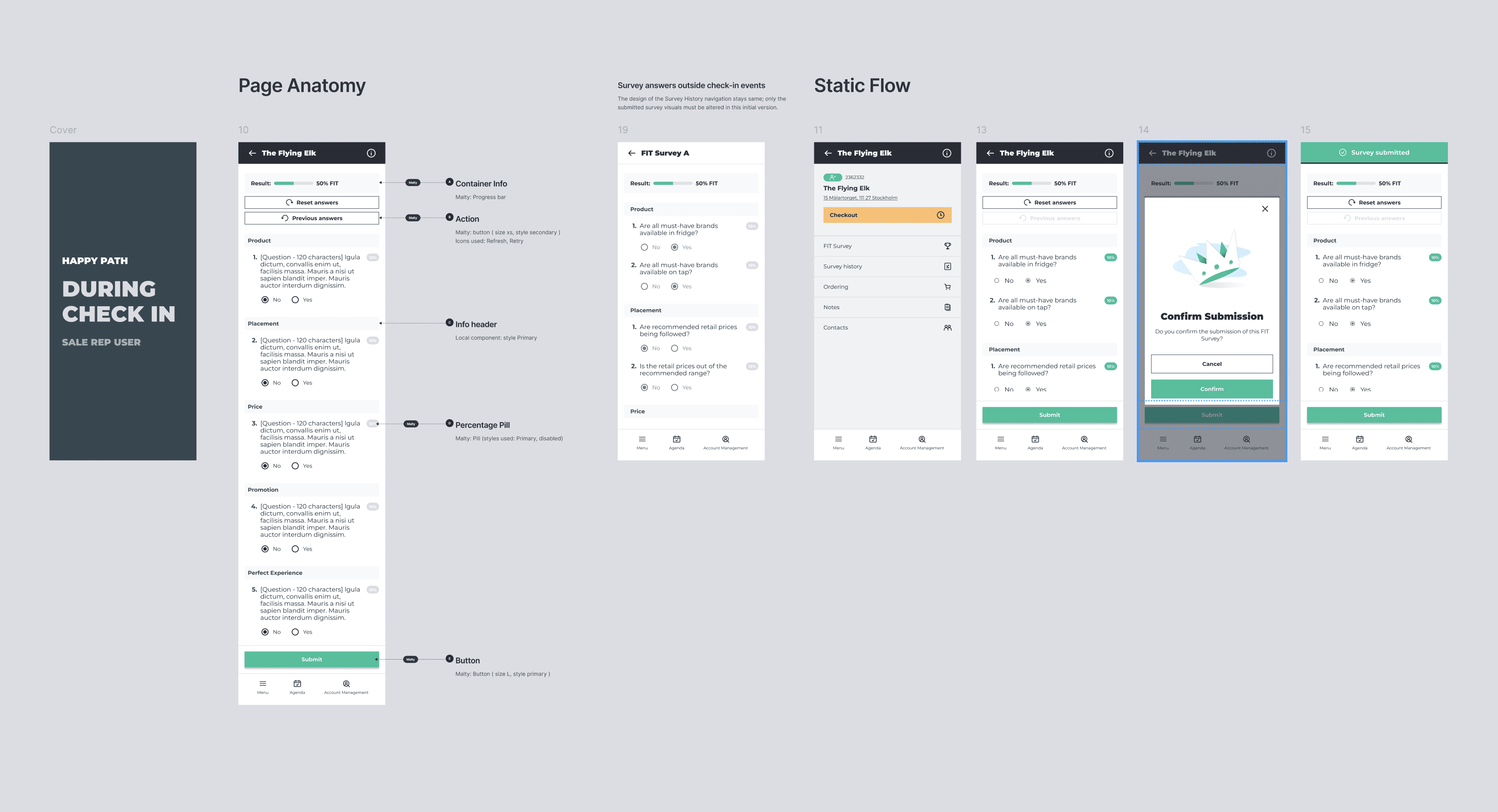
Screens from a feature with annotations linking decision to problem.
The last deliverable
When my engagement on CADI concluded in December 2023, I treated the handover as a design deliverable. Several threads were deliberately documented rather than rushed to closure.
The analytics framework I had built was complete and ready for implementation. The UMUX satisfaction survey, approved by the Research Lead, PO, and PM, had a clear implementation path mapped out. The ordering module redesign, the direct answer to what the Phase 1 research had revealed, was scoped and positioned as the next phase. None of these were abandoned; they were handed over with enough context for someone to continue.
I have always believed that in a product operating across 7 markets with no prior design infrastructure, the risk of losing institutional knowledge is greater than the risk of any individual design decision. The handover document I wrote on the way out was the last expression of that belief.
The research I conducted in 2023 identified the question the CADI ordering module still hasn't answered. That question is the starting point for what comes next.